

News
Focus on co-products helps drive performance pick up and address variable grass silage
Careful changes to the ration to complement multi-cut silage quality, alongside a number of herd management and protocol adjustments has seen award winning Leyburn dairy producers Metcalfe Farms achieve significant milk production performance improvements, with a focus on co-products helping to further support a commitment to producing milk sustainably.
Metcalfe Farms is owned and run by brothers David, Brian and Philip Metcalfe, with Philip managing the dairy herd on 525ha at Washfold Farm, part of the 1300ha within the farm business.
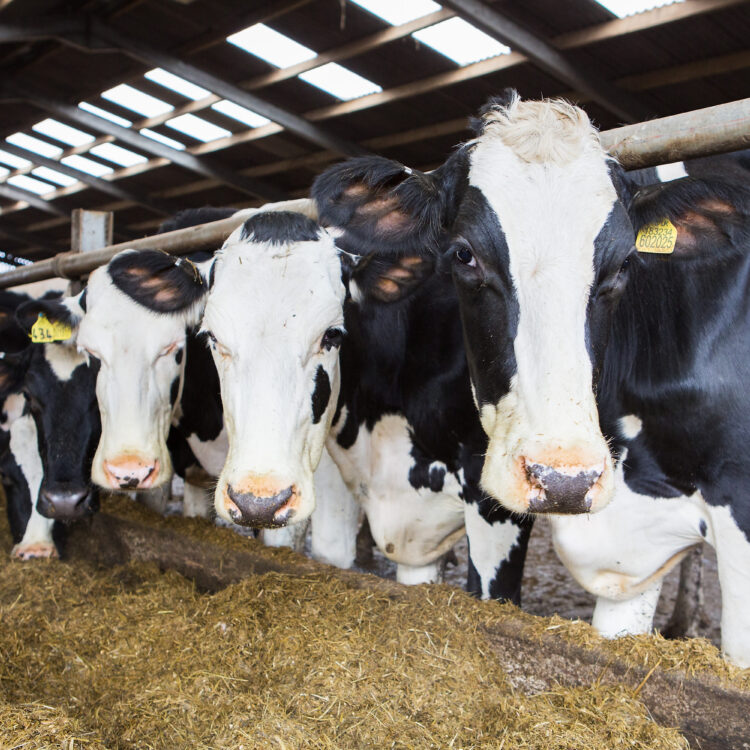
Philip oversees the dairy, which currently has 1300 pedigree Holsteins and 972 youngstock, having expanded since the addition of a new parlour and further cow accommodation in 2016. The cows are split into far-off drys, close up drys, fresh cow and heifer groups for the first 21 days of lactation, then main milker groups. Staler cows or barrens are put onto a detuned ration to control condition.
On a liquid milk contract with Yorkshire-based Paynes Dairies, at the last milk recording on 21st July, Metcalfe Farms had 1060 cows in milk and 154 dry cows, showing an average yield of 39kgs per cow and around 3.1% protein and 3.8% butterfat.
Cows have really picked up performance this year, with a number of factors playing a part.
In response to the very hot straights market earlier in the year, Metcalfe Farms introduced 6.5kg of an alternative moist feed C*Traffordgold in February to replace hulls, ground maize and soya.
Dr Anna Sutcliffe, KW nutritionist explains, “Winter feed contracts were well bought and replacing straights with C*Traffordgold reduced the requirement for very expensive material over the summer feeding period. Cows have performed very well with the inclusion of C*Traffordgold in the ration.”
Even at the well bought winter contracts, it saved 2p/per head/per day, and moving to the summer pricing this would equate to a saving in the region of 15p/per head/per day.
In mid-May, the cows moved onto some excellent 2020 first cut grass silage and this was fed exclusively from the end of June, where yields have really picked up.
Wholecrop wheat and grass silage
The topography of the North Yorkshire farm does not lend itself well for growing maize, so Philip has moved away from maize silage and focuses on wholecrop wheat and grass silage, which grows more consistently and cost-effectively.
The farm cropping includes approximately 600 acres of winter wheat, mostly taken as wholecrop, 900 acres of grass, 300 acres of rough grazing, alongside 200 acres of heather moorland and woodland.
The grass silage is managed with a multi-cut system, aiming for five cuts. The first cut this year was hampered by the incredibly cold spring, with frosts throughout April which really curtailed growth and nitrogen uptake.
The first cut was taken early and as May was so wet, protein was surprisingly low for a first cut at 14.2%, normally expected around 16-18%. While the energy value was good, the high lactic acid content meant it has not been the easiest material to work with.
Common with many this year, the NDF is low at 41.2%, but the indigestible lignin content of this silage is high at almost 4%.
The wholecrop is taken at the ripe cheese stage, often when the plant is still a little green, meaning the energy value is pretty good as the stalk is more digestible.
“10.7 MJME/kgDM is a good value for wholecrop wheat. The starch content is also very good at nearly 28%. It feeds really well and all the grain is utilised,” explains Dr Sutcliffe.
Co-products play a significant role
Co-products play a significant role to support the all-year-round TMR, specifically brewers grains, C*Traffordgold, wheat syrup and LactoBoost, a high energy, lactose rich liquid providing a rapidly available source of rumen energy.
“The syrup, grains and C*Traffordgold all bring a source of rumen degradable protein which means less reliance on soya, and we complement the rumen degradable protein with 2.4kg of NovaPro, the rumen protected rape expeller, to get high quality by-pass protein,” explains Dr Sutcliffe.
The syrup and C*Traffordgold are high energy which helps support the yield and also contain fragments of yeast which are stimulatory to rumen bug growth. In essence, the more bugs, the more forage digested in the rumen, meaning the more energy for the cow.
“On top of that we feed a live yeast to optimise conditions in the rumen for the bugs to grow and proliferate. The high lactic acid content of the grass silage is countered by a long-acting rumen buffer, while LactoBoost brings a source of sugars to the ration,” says Dr Sutcliffe.
“This is really helpful to stimulate the fibre digesting bugs, especially important this year with this high lignin grass silage,” she adds.
Starch sources are ground maize (minimal at 0.5kg), C*Traffordgold, soda barley and wholecrop wheat. Energy density of the ration is increased by feeding a combination of protected C16 and C18 fatty acids.
Bespoke minerals plus additional limestone flour is fed to ensure Calcium in the ration is kept at around 0.9% in DM, helping reduce the risk of potential milk fever incidences. Organic forms of Selenium, Copper and Manganese are also fed to aid energy metabolism and fertility.
Wider commitment to sustainability
Cow health and welfare protocols are a priority at Metcalfe Farms, the 2018 RABDF Gold Cup winners, as is evident in the approach adopted this year to balance rations and improve performance.
Philip and his brothers are supported by dedicated and trained staff, covering all aspects of herd management, including milking routines, cow nutrition, calf rearing and dry cow care. These practices, combined with breeding cows for type, good locomotion and avoiding extremes, have promoted improvements in overall herd performance.
There has also been a focus on a sustainable and environmentally responsible approach to milk production, and overall farm operations.
With research indicating the majority of co-products carry a significantly lower carbon footprint than imported feed, the heavy reliance on co-products and use of only a small amount of imported soya, hulls and ground maize in the Metcalfe Farms ration means it carries a lower carbon footprint than a traditional straight based ration.
A 200KW AD plant has also been installed at Washfold Farm, taking all the farm slurry and converting it into electricity. This provides all of the farm’s electricity requirements, with the surplus sold into the National Grid.
“We need to focus on producing milk sustainably,” explains Mr Metcalfe, adding “Our anaerobic digester ticks a lot of those boxes. But we can go further by using technology to save electricity or growing our forage and purchasing feed more efficiently for instance.”
-
Feed efficiency key to dairy resilience this spring
Concerns over falling milk prices, alongside rising input costs against the backdrop of the volatile political and conflict landscape in…
-

High energy liquid feed helps add value and enhance milk production
With the likelihood of significant variability in grass, wholecrop and maize forages across Scotland this coming winter, dairy producers should…
-

Improved feed efficiencies help boost margins and reduce carbon footprints
Accurate and real-time data exchange key to improving feed efficiency Embracing new technologies and focusing on feed efficiencies and reduced…


